
Water damage from fire sprinklers is one of the most disruptive problems a property team can face. Ceilings come down, tenants are displaced, and the cleanup bill arrives before anyone has answered the real question: why did it happen?
This article explains why sprinkler leaks cause so much damage, how to respond when they occur, and what owners and managers can do to prevent a repeat.
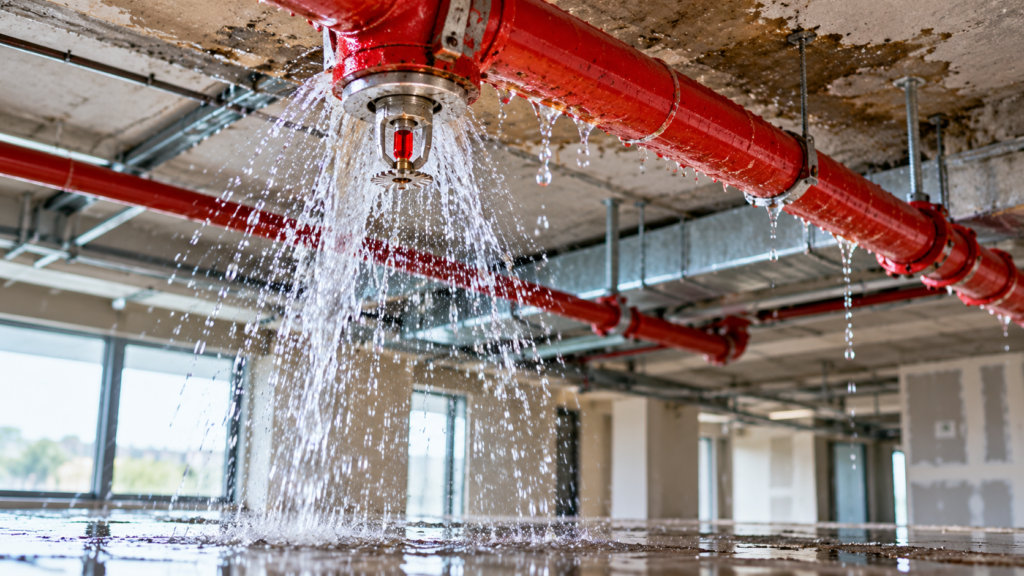
Why Sprinkler Leaks Cause So Much Damage
A wet fire sprinkler system is full of pressurized water at all times, which is what lets it respond instantly in a fire. It also means a breach in the piping can release water continuously until the affected section is isolated. A small perforation can become a major event if it goes unnoticed above a ceiling, over equipment, or in an unoccupied space.
Water damage from fire sprinklers also tends to spread out of sight. Moisture can travel along pipes and through ceiling cavities before it shows up as a stain, which makes the visible damage a poor measure of the real extent.
Where Water Damage From Sprinkler Leaks Comes From
- Mechanical damage to piping or sprinkler heads.
- Failed fittings, gaskets, or couplings.
- Freezing in exposed areas.
- Internal corrosion that gradually perforates pipe walls, producing pinhole leaks.
The first three are usually one-time events. Corrosion is different because it is progressive. If it is the cause, the damage you have already seen may be the first of several. Our guide to pinhole leaks in fire sprinkler systems explains how this plays out.
What to Do Right Away
- Get the leak isolated. Call your licensed fire protection contractor. Follow your impairment procedures if any part of the system must be taken out of service.
- Protect occupants and contents. Move people, equipment, and sensitive materials away from the affected area.
- Start water removal quickly. Standing water and wet materials left in place can lead to additional damage, so engage a restoration professional promptly.
- Document everything. Photograph the damage, the leak source, and the pipe before it is repaired. Note dates, locations, and who responded.
- Save the failed component. A removed pipe section or fitting shows the failure mode, and it may reveal internal corrosion that is otherwise invisible.
Find the Cause, Not Just the Leak
Repairing the failed section and restoring the ceiling doesn’t answer why the pipe failed. If the leak was caused by internal corrosion, the same conditions are still present in the rest of the system.
Look for patterns that suggest a systemic issue:
- More than one leak in the same area or on the same branch.
- Dark or discolored water during drain tests. See black water in fire sprinkler systems.
- Pitting or deposits on removed pipe.
- A history of repairs that haven’t stopped the problem.
If you see any of these, it is time to look inside the system. Our overview of microbiologically influenced corrosion explains the most common underlying cause.
How an Assessment Helps
A fire sprinkler corrosion assessment gives owners and managers facts they can act on. It includes water quality analysis, internal video inspection with a serpentine borescope, and ultrasonic wall thickness testing. The result is a written report that identifies the root cause, shows the extent of damage with high-resolution images, and recommends a defined scope of repairs.
That documentation is useful beyond the repair itself. Annotated drawings with color-coded legends make it easier to communicate with contractors and to compare bids on equal terms, and the written findings give ownership a clear basis for budgeting.
Preventing the Next Incident
After repairs, the priority is keeping the conditions that cause corrosion under control:
- Treat the system, don’t just flush it. Flushing with fresh water can add oxygen and nutrients that re-energize bacteria.
- Address air release. Poor or misplaced air release creates high points where oxygen collects and accelerates corrosion.
- Monitor and test. Ongoing monitoring and periodic testing show whether water chemistry stays within protective parameters.
- Use a corrosion control program. Our Corrosion Control Program combines customized treatment, monitoring, and annual sampling to help extend system life and reduce leaks.
Questions to Answer After Any Sprinkler Incident
Once the immediate emergency is over, a short review turns a bad day into useful information:
- Was this a one-time failure, or has this area leaked before?
- What exactly failed: pipe, fitting, gasket, or head?
- Did anyone inspect the removed component for internal corrosion?
- Has the water ever been tested?
- Has anyone looked inside the piping?
If most of these come back as unknowns, the incident hasn’t really been diagnosed yet, and a repeat is more likely.
Communicating With Tenants and Ownership
After a leak, tenants want to know what happened and whether it will happen again, and ownership wants to know what it will cost. Clear communication is much easier when you have facts. Written findings, images from inside the pipe, and a defined scope of work let you tell tenants what was found and what is being done, and let you give ownership a realistic budget instead of an open-ended maintenance estimate. Your restoration vendor or insurer may also ask for documentation, so keep photos, reports, and invoices together in one place.
What to include in a report to ownership
- What happened, where, and when.
- The cause, as far as it is known, and how that was confirmed.
- Whether the issue is isolated or likely to recur.
- The recommended scope, with an estimate and a timeline.
- The plan to prevent repeat incidents.
Budgeting for Prevention Versus Emergency Repairs
Emergency repairs are unpredictable by nature: the service call, the cleanup, the tenant disruption, and the repair that has to be repeated. Prevention is a more predictable line item. Owners and managers who understand the condition of their system can plan repairs on their own schedule rather than in reaction to a leak. If you manage multiple properties, our page for property owners and managers describes how Corrosolve supports that kind of planning.
Where to Start
If your property has already had a sprinkler leak, begin with the records: when it happened, what failed, and whether it has happened before. Then ask for the interior of the piping to be evaluated and the water to be tested. With those findings in hand, you can decide on repairs and prevention with confidence, rather than waiting to see whether the next leak arrives at a worse time. Our guide to what to do when fire sprinklers are leaking is a good companion read.
Frequently Asked Questions
Why does a fire sprinkler leak cause so much water damage?
Wet sprinkler systems hold pressurized water, so a breach can release water continuously until the section is isolated. Water can also spread through ceilings and walls before damage becomes visible.
What should I do immediately after water damage from a sprinkler leak?
Have your fire protection contractor isolate the leak, protect occupants and contents, start water removal quickly, document the damage with photos, and keep the failed pipe section or fitting for evaluation.
How do I know whether corrosion caused the leak?
Repeat leaks in the same area, dark or discolored water, and pitting or deposits on removed pipe all suggest internal corrosion. An assessment with video inspection and wall thickness testing can confirm it.
How can I prevent water damage from fire sprinklers in the future?
Identify and address the root cause, avoid relying on flushing, improve air release where needed, and use ongoing monitoring, testing, and a corrosion control program to protect the piping.
Dealing with water damage from a sprinkler leak? Corrosolve’s consultants can find out what is happening inside your piping and recommend a scope that matches the facts. Request a fire sprinkler corrosion assessment or call 619.255.9547.